

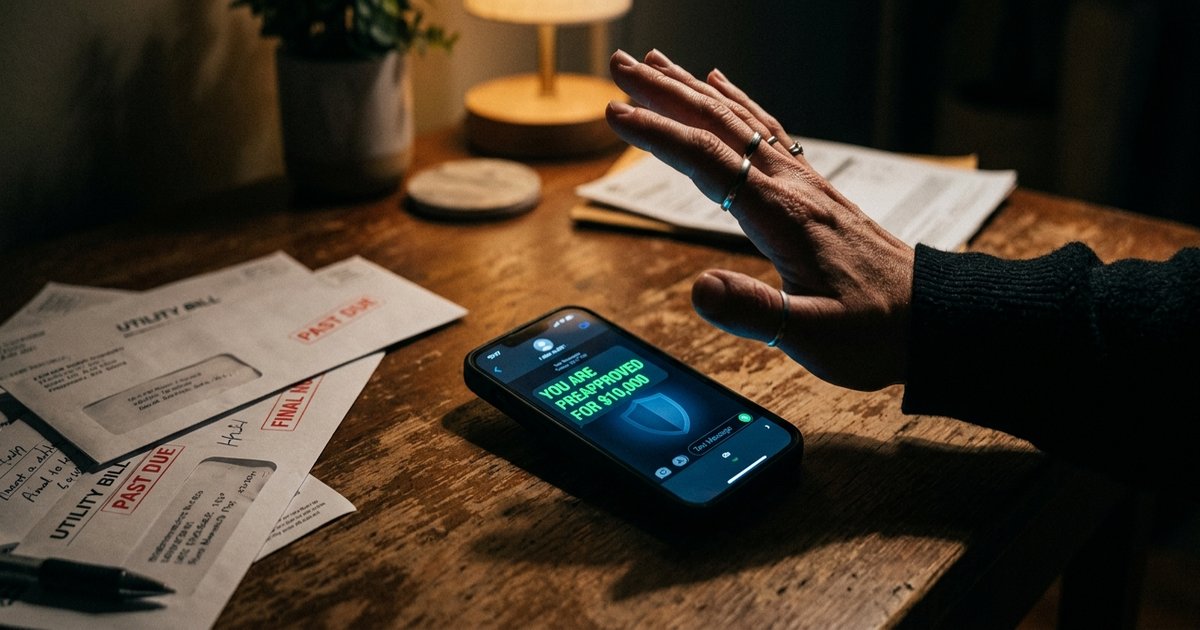
It's 11 p.m. Your bank turned you down this morning. Your credit score sits at 540, and you need $3,000 by the end of the week. So you type "loans for bad credit" into your phone and start scrolling. Then a text pops up: "You're preapproved for $10,000. Tap here to claim your funds."
Stop. Right there. What you do in the next five minutes will either cost you money or save it.
I spent 25 years watching borrowers walk into my office after falling for schemes exactly like that one. The pattern was always the same: someone in a tight spot, a too-good offer, and a scammer who knew exactly which buttons to push. The borrower felt stupid afterward. They shouldn't have. These scams are designed by people who study desperation for a living.
In 2024, Americans lost over $12.5 billion to fraud, a 25% jump from the year before, according to the FTC's Consumer Sentinel Network data. That's not just more scams happening. The scams are getting better at working. The percentage of fraud reporters who actually lost money climbed from 27% to 38%. Nearly 19,000 of those reports fell into a single category: advance payments for credit services. Translation: people paying upfront fees for loans they never received.
About 16.3% of Americans carry a FICO score between 300 and 599, per Experian data from late 2024. That's roughly one in six adults. Scammers know this group is searching harder, accepting worse terms, and less likely to verify a lender before handing over personal information. If that describes your situation right now, this article is for you.
Here are seven real scam patterns pulled from FTC enforcement cases, followed by a step-by-step checklist you can finish in 10 minutes flat.
Scam 1: The Advance-Fee Trap
This is the oldest trick in the book, and it still works. A "lender" contacts you (or you find them online) and says you're approved for a personal loan. There's just one catch: you need to pay a processing fee, an insurance fee, or a "good faith deposit" before the money can be released.
You pay the fee. The loan never shows up. The lender disappears.
Here's what most people don't know: this is already illegal. The FTC's Telemarketing Sales Rule makes it a federal violation for any company doing business by phone to collect payment before delivering a loan. Period. If someone asks you to pay before you receive funds, they are breaking the law. There's no gray area here.
The language these scammers use is remarkably consistent. Victims describe hearing phrases like "just a small insurance fee to release the funds" or "the fee is required to offset the risk because of your credit situation." That second one is clever because it feels logical. Bad credit means more risk, so a fee makes sense, right? Wrong. Legitimate lenders bake their risk into the interest rate. They don't ask you to wire money to a prepaid card before disbursement.
In a related scheme, the operators behind USA Student Debt Relief extracted more than $7.3 million in illegal advance fees by impersonating the Department of Education. The FTC permanently banned them from the industry and forced them to surrender over $1 million in assets.
Scam 2: The Fake Lender Website
This one has gotten sophisticated. Scammers build websites that look nearly identical to legitimate lender sites, sometimes cloning the layout, logo, and even the terms of real companies. The URL might be one letter off. The "About Us" page reads like a real company. There might even be fake reviews.
But certain things are always missing.
No NMLS (Nationwide Multistate Licensing System) number. No verifiable physical address. No state licensing disclosures. Interest rates that are suspiciously low for a bad-credit lender (if someone's offering you 4% APR with a 520 FICO score, that's not a deal, it's a trap). The site might have a "secure application" form that asks for your Social Security number, bank account details, and employer information. Once you submit that, the scammer has everything they need for identity theft.
Every legitimate lender operating in the United States must be registered with the NMLS, and that registration is searchable by anyone at nmlsconsumeraccess.org. If a company isn't in that database, walk away. No exceptions.
Scam 3: The "Guaranteed Approval" Phone Call
Your phone rings. The caller says they're from a lending company, and you've been selected for a guaranteed loan. No credit check required. Instant approval. All you have to do is confirm some personal details.
No legitimate lender guarantees approval. Not one. A real lender evaluates your income, your debt-to-income ratio, your credit history, and your repayment capacity. If someone skips all of that and tells you you're approved before asking a single financial question, they're not lending you money. They're stealing your information.
The FTC issued a consumer alert in September 2025 specifically about unsolicited loan calls. Their guidance was blunt: ignore them. A real lender doesn't cold-call you with a guaranteed offer. If you didn't apply for it, it's not real.
These calls often use high-pressure tactics. "This offer expires today." "We can only hold your approval for 24 hours." "Reply YES to confirm you still want to claim the loan." That urgency is manufactured. A legitimate loan approval doesn't evaporate because you took a day to think about it.
Scam 4: The Loan Text Message Phish
In January 2026, the FTC felt the need to issue a standalone consumer alert about fake loan text scams. That tells you how fast this channel is growing.
The text usually says something like "You're preapproved for $10,000" or "Congratulations, your loan application has been approved." There's a link. If you tap it, you land on a fake application page designed to harvest your personal data. Sometimes the link installs malware on your phone.
The FTC's advice is straightforward: don't reply. Don't click the link. Forward the text to 7726 (that's the spam-reporting shortcode every major carrier supports). Report it at ReportFraud.ftc.gov. And if you already clicked and entered information, go directly to IdentityTheft.gov.
I want to be clear about something. Feeling tempted by these texts doesn't make you gullible. When you've been denied by a bank and you're under financial pressure, a text saying "you're approved" hits different. Scammers know this. They send these messages in volume precisely because a small percentage of recipients are having the worst financial week of their lives. The timing isn't coincidence. It's targeting.
Scam 5: The Phantom Debt Collector
You get a call or letter demanding payment on a debt. The caller is aggressive. They threaten legal action. They say you'll go to jail. You don't remember the debt, but you're scared, so you pay.
The debt never existed.
In November 2024, the FTC shut down a Georgia-based phantom debt operation that had collected over $7.6 million from victims by threatening them with imprisonment for debts that were completely fabricated. Seven point six million dollars, collected from people who owed nothing.
The Fair Debt Collection Practices Act makes it illegal for any collector to threaten you with jail time. It also prohibits them from attempting to collect debts they know are bogus. If someone calls you about a debt you don't recognize, you have the legal right to request written verification. A legitimate debt collector must provide it. A scammer won't, because the debt doesn't exist.
Here's the part that should make you angry: shame keeps this scam profitable. Most victims never report phantom debt because they're embarrassed. They think they should have known better. But the CFPB has published guidance specifically on distinguishing legitimate debt collectors from scammers, and one of the top signs of a scam is a collector who refuses to provide written documentation of what you supposedly owe.
Scam 6: The Credit Repair Bait-and-Switch
"We'll fix your credit for $500. Pay now, and we'll start removing negative items from your report."
This violates federal law. The Credit Repair Organizations Act (CROA) prohibits credit repair companies from collecting fees before services are fully performed. It also requires a written contract and gives you a three-day cancellation window. Any company demanding payment upfront for credit repair is breaking the law before they've done a single thing for you.
What makes this scam especially harmful is that it preys on people who are already trying to do the right thing. You want to improve your credit so you can qualify for a legitimate loan. Someone offers to help. You pay. Then either nothing happens, or worse, they file fraudulent disputes with the credit bureaus that temporarily inflate your score before crashing it back down.
Legitimate credit counseling exists. The National Foundation for Credit Counseling (NFCC) is a good starting point for finding accredited counselors who charge little to nothing for their services. If someone wants hundreds of dollars upfront to "fix" your credit, they're the problem, not the solution.
If you want to improve your credit on your own instead, a 30-day credit score improvement sprint can produce meaningful results using free tools and tactics that don't require paying anyone.
Scam 7: The Loan-Flipping Scheme
This one is subtler, and it sits in a gray area between outright fraud and predatory lending. Here's how it works: a lender approves you for a loan. Before you've paid it off, they contact you about refinancing into a "better" loan. That new loan rolls in the old balance plus new fees. Then they do it again. And again. Each time, you owe more, your fees stack up, and the lender earns another round of origination charges.
Not every refinance offer is a scam. Sometimes refinancing makes genuine financial sense. The red flag is when a lender pushes you to refinance repeatedly, when the new terms aren't meaningfully better, or when you notice the total amount you owe keeps climbing despite making regular payments.
Payday lenders and some subprime auto lenders have historically been the worst offenders here. If a lender seems more interested in rolling your loan over than in you actually paying it off, that's a problem.
The 10-Minute Lender Verification Checklist
Before you share your Social Security number, bank account information, or any personal data with any lender, run through these six steps. They take about 10 minutes total. Set a timer if you want. This is not optional.
Step 1: Check NMLS Consumer Access (2 minutes)
Go to nmlsconsumeraccess.org. Search the company name. Every legitimate consumer lender in the United States must be registered here. If the company doesn't appear, stop. You're done. That's not a real lender.
If they do appear, note their NMLS number and confirm they're licensed to operate in your state. A company licensed in Texas but not in Illinois can't legally lend to you in Chicago.
Step 2: Search Your State's Financial Regulator (2 minutes)
Every state has a financial regulatory agency (sometimes called the Department of Financial Institutions, Department of Banking, or Division of Finance). Search "[your state] + financial regulator" and look up the lender on that site. Licensing requirements vary by state, and this is where you confirm the company is authorized to do business where you actually live.
Step 3: Look Up the BBB Profile (2 minutes)
Go to bbb.org and search the company name. Check two things: whether the company has a profile at all, and what the complaint history looks like. A few complaints aren't unusual for any business. A pattern of complaints about fees charged before loan disbursement, or complaints about loans that were promised but never funded, is a disqualifying signal.
Step 4: Run a Quick Search for Complaints (2 minutes)
Open your browser and search "[company name] scam" and "[company name] complaints." Scan the first two pages of results. You're looking for patterns, not isolated grievances. One angry review could be anything. Fifteen people describing the same advance-fee scheme is a pattern you can't ignore.
Step 5: Verify the Physical Address (1 minute)
Take the address from the company's website and drop it into Google Maps. Switch to Street View. Does a real office exist at that location? Or is it a vacant lot, a UPS Store mailbox, or a residential home? Legitimate lenders have real offices. Some operate online-only, but they still have a verifiable corporate headquarters.
Step 6: Confirm No Upfront Fees Are Required (1 minute)
Ask the lender directly: "Do I need to pay any fees before receiving my loan funds?" If the answer is yes, in any form (processing fee, insurance deposit, good faith payment, verification charge), walk away. Legitimate lenders deduct origination fees from the loan disbursement or roll them into the loan balance. They do not ask you to send money before you receive money.
What to Do If You've Already Been Scammed
If you've already paid money or shared personal information with a scammer, act fast. Every hour matters.
- Report to the FTC at ReportFraud.ftc.gov. This feeds the federal database that drives enforcement actions.
- File a complaint with the CFPB at consumerfinance.gov/complaint. Even if the CFPB has faced operational challenges recently, the complaint portal remains active.
- Contact your state attorney general's office. State AGs pursue lending fraud aggressively and often have dedicated consumer protection divisions.
- Freeze your credit at all three bureaus (Equifax, Experian, TransUnion). A freeze is free and prevents anyone from opening new accounts in your name.
- Visit IdentityTheft.gov if you shared your Social Security number or bank account details. The site generates a personalized recovery plan.
Do all five. Not one or two. All five. The scammer who has your information isn't going to wait while you think about it.
The Bottom Line on Avoiding Bad Credit Loan Scams
Legitimate lenders who work with borrowers who have bad credit absolutely exist. They charge higher interest rates because that's how they account for risk. They verify your income and your ability to repay. They show up in the NMLS database and on your state regulator's website. And they never, under any circumstances, ask you to pay before they lend.
The 10-minute checklist above isn't a suggestion. Treat it like a requirement before you hand over a single piece of personal information to any lender you found online. Ten minutes of verification is cheaper than $3,000 you'll never get back.
Once you've confirmed a lender is legitimate, understanding how to strategically choose your first bad credit loan will help you pick one that actually builds your credit, not just one that funds your account. The right first loan can set you up for better rates within 12 to 18 months.
Frequently Asked Questions About Bad Credit Loan Scams
How do I know if a bad credit loan offer is a scam?
The strongest warning signs are upfront fee requests, guaranteed approval without a credit check, unsolicited contact (calls, texts, or emails you didn't initiate), and pressure to act immediately. Legitimate lenders never guarantee approval, and federal law prohibits collecting fees before delivering a loan when the offer is made by phone.
What is an advance-fee loan scam?
An advance-fee loan scam is when a fake lender tells you you're approved for a loan but requires you to pay a fee (called a processing fee, insurance fee, or good faith deposit) before releasing the funds. You pay the fee. The loan never arrives. The FTC's Telemarketing Sales Rule makes this practice illegal.
Where can I verify if a lender is legitimate?
Start at nmlsconsumeraccess.org, the NMLS Consumer Access portal, where every licensed lender in the U.S. must be registered. Then check your state's financial regulatory agency to confirm the lender is authorized to operate in your state. You can also search bbb.org for complaint history and run a quick web search for "[company name] scam" to check for patterns of fraud reports.
Can a legitimate lender guarantee approval for a bad credit loan?
No. Any lender that guarantees approval without reviewing your income, debts, and credit history is either lying or planning to trap you in predatory terms. Real lenders assess your ability to repay before making a lending decision. A "guaranteed" offer with no financial evaluation is a red flag every time.
What should I do if I already paid money to a loan scammer?
Report the scam to the FTC at ReportFraud.ftc.gov, file a complaint with the CFPB, contact your state attorney general, freeze your credit at all three bureaus (Equifax, Experian, TransUnion), and visit IdentityTheft.gov if you shared sensitive personal data. Take all of these steps, not just one.
Are loan offers sent by text message legitimate?
Almost never. The FTC issued a dedicated consumer alert in January 2026 about fake loan text scams. If you receive an unsolicited text saying you're "preapproved" for a loan, do not reply and do not click any links. Forward the text to 7726 to report it to your carrier, and file a report at ReportFraud.ftc.gov.
What is a phantom debt scam?
A phantom debt scam is when someone contacts you demanding payment on a debt that doesn't exist. The caller may threaten legal action or jail time to pressure you into paying. The Fair Debt Collection Practices Act gives you the right to request written verification of any debt. If a collector refuses to provide documentation, it's a scam. In November 2024, the FTC shut down a Georgia-based phantom debt operation that had collected over $7.6 million from victims.
