

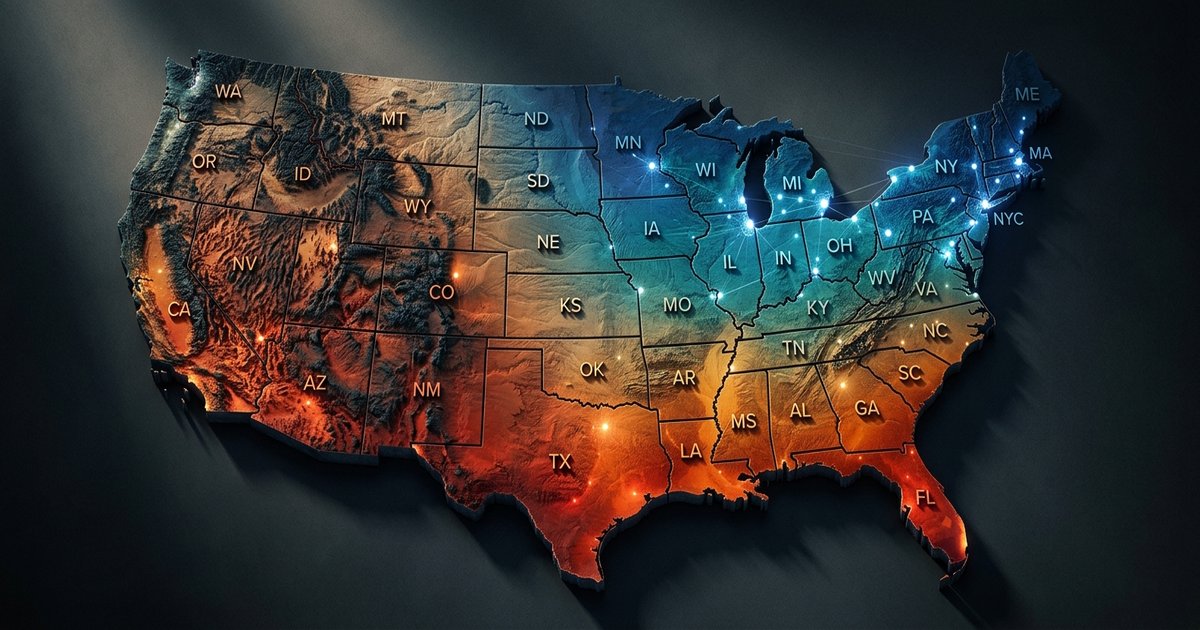
A borrower with a 550 FICO score in Illinois can get a personal loan capped at 36% APR. The same borrower, same score, same income, applying to the same online lender in Missouri, could be quoted 89% or higher. There is no federal cap on personal loan interest rates, and the state-by-state variation is so extreme that your zip code may matter more than your credit score when determining the true cost of a bad credit loan.
Same Credit Score, Different Universe
Forty-five states and Washington D.C. cap interest rates and fees for at least some consumer installment loans, according to the National Consumer Law Center's 2025 report on predatory installment lending. But "at least some" is doing heavy lifting in that sentence. The caps vary from a meaningful 36% APR in states like New York and Illinois to effectively nonexistent in states like Utah and Missouri, where the legal ceiling is so high it barely functions as a constraint.
Six states have no numerical cap on interest rates for larger loans: Alabama, California (for some loan types), Idaho, South Carolina, Utah, and Wisconsin. Delaware and Missouri have no interest rate limit and no legal bar on unconscionability, meaning there is no mechanism for a court to void a loan simply because the rate is excessively high.
Since mid-2024, the trend in some states has actually gotten worse. Missouri added new lender fees. Mississippi extended a law allowing 300%+ APR to wider loan categories. Tennessee increased both the interest rates and fees that lenders are permitted to charge. If you are borrowing with bad credit in one of these states, the rules are moving against you.
How State Laws Create Different Borrowing Worlds
Four types of state laws shape what bad credit borrowers actually pay.
Usury caps set the maximum interest rate a lender can charge. These vary from 5% (the baseline in states like Delaware, Illinois, Michigan, and Wisconsin) to 15% or higher (New Mexico, South Dakota). But baseline usury rates often apply only to unlicensed lenders. Licensed consumer finance companies, banks, and credit unions frequently operate under different, higher caps or are exempt entirely. The "legal maximum" published on a state's website is almost never what borrowers actually encounter.
Payday lending bans prohibit or severely restrict short-term, high-cost lending. Eighteen states plus D.C. have banned payday lending or capped rates at or near 36% APR. Five of those bans were enacted since 2020 (Nebraska, Hawaii, Illinois, New Mexico, Minnesota), representing a clear trend toward consumer protection in some parts of the country.
Licensing requirements determine which lenders can operate in a state and under what conditions. States with rigorous licensing tend to have fewer predatory operators. States with loose licensing or "credit access business" frameworks (like Texas) create loopholes that allow high-cost lending to operate under a different regulatory label.
Bank preemption complicates everything. Nationally chartered banks are not bound by state usury laws under federal preemption. This is how the "rent-a-bank" model works: an online lender partners with a bank in a permissive state (often Utah or Delaware), originates loans through the bank's charter, and charges rates that exceed the borrower's home state cap. A borrower in a "strong protection" state can still receive a 100%+ APR offer from one of these arrangements. Colorado's November 2025 appeals court victory, where the 10th Circuit ruled the state could enforce its rate caps on out-of-state lenders, may begin to change that dynamic, but the legal battle is far from settled.
The State Power Rankings: Four Tiers
These rankings draw from the NCLC's 2025 state-by-state protection ratings, the Center for Responsible Lending's payday lending analysis, and Pew Charitable Trusts data. The tiers reflect the overall regulatory environment for bad credit borrowers, considering rate caps, payday bans, licensing rigor, and recent legislative direction.
Tier 1: Strong Protections
States in this tier have banned or severely restricted payday lending, cap installment loan rates at or near 36% APR, and have active enforcement. If you live here, the law is working in your favor, though bank preemption and online lending can still create gaps.
States: New York, Colorado, Illinois, New Mexico, Connecticut, Massachusetts, New Jersey, North Carolina, Arkansas, Montana, Nebraska, Vermont, New Hampshire, Georgia, Pennsylvania, West Virginia, Maryland, Arizona, South Dakota, and Washington D.C.
What borrowers here should know: You have real protections, so use them. Lenders operating in your state must comply with your state's rate caps. If an online lender offers you a rate that exceeds your state's legal maximum, check whether they are routing the loan through an out-of-state bank charter. File a complaint with your state attorney general if the rate does not match what state law allows. Credit unions in these states are particularly strong alternatives, as federal credit unions cap most personal loans at 18% APR.
Tier 2: Moderate Protections
These states have some consumer protections in place, including rate caps for certain loan types, but with significant gaps, loopholes, or higher thresholds that still expose borrowers to costly products.
States: California, Ohio, Minnesota, Hawaii, Oregon, Washington, Florida, Indiana, Michigan, Virginia, Kentucky, Louisiana, Oklahoma, Kansas, Rhode Island, Maine, Alaska, Iowa, North Dakota.
What borrowers here should know: Your state offers partial protection, but the details matter. Ohio reformed its payday lending in 2018 with rate caps and structural requirements, but installment lending at higher rates still exists. California caps payday loans at $300 but has no rate cap on larger installment loans. Florida allows payday lending but limits borrowers to one loan at a time with a required 24-hour cooling-off period. Read the terms carefully. Do not assume the rate you are offered is the best your state allows.
Tier 3: Weak Protections
These states allow high-cost installment lending with minimal caps, have permissive licensing frameworks, or have recently weakened consumer protections.
States: Texas, Tennessee, Alabama, South Carolina, Idaho, Wisconsin, Nevada, Wyoming, New Hampshire (for some product types), Hawaii (for some product types).
What borrowers here should know: The legal ceiling in your state may be higher than what any responsible lender would charge. In Texas, payday and title lenders operate as "credit access businesses," charging fees that push effective APRs well above the stated 18% usury cap. This is legal under current Texas law. In Tennessee, recent legislation increased both permissible interest rates and fees. You need to self-protect: compare rates across multiple lenders, check credit union options, and never accept the first offer. Using a comprehensive loan comparison checklist is essential when your state's laws offer limited protection.
Tier 4: Minimal Protections
These states have no meaningful cap on consumer loan interest rates, no bar on unconscionable pricing, or have actively expanded lender permissions in recent years. Borrowing with bad credit here carries the highest risk of predatory terms.
States: Utah, Missouri, Mississippi, Delaware.
What borrowers here should know: You are in a regulatory environment that offers very little between you and the most aggressive lending terms the market will bear. Utah has no rate cap on consumer installment loans, which is why many rent-a-bank operations are chartered there. Missouri has no interest rate limit and no unconscionability standard. Mississippi had the lowest average credit score in the nation in 2025 (677, per WalletHub) and allows APRs above 300% on certain loan types. Delaware serves as a charter state for many online lenders precisely because of its permissive regulations.
If you live in a Tier 4 state, your most important move is to borrow from federally regulated institutions. Federal credit unions are capped at 18% APR for most personal loans regardless of what state you are in. That federal cap overrides the absence of a state cap.
The Five Biggest State-Level Traps for Bad Credit Borrowers
1. The Credit Access Business Loophole (Texas)
Texas classifies many payday and title lenders as "credit access businesses" that broker loans through third-party lenders. The fee structure allows charges on top of the loan itself, pushing effective costs far above what the state's 18% usury cap would suggest. This is a legal structure designed to circumvent the spirit of the usury law while complying with its letter.
2. Rent-a-Bank Schemes (Nationwide)
Online lenders partner with nationally chartered banks in permissive states to originate loans that exceed the borrower's home state rate caps. Because federal preemption allows banks to "export" the interest rate of their home state, the borrower's state protections can be effectively bypassed. Colorado's 2025 court victory is a counterweight, but this practice remains widespread. Knowing how to vet online lenders is critical for identifying these arrangements.
3. "Legal but Predatory" Installment Loans at 100%+ APR
In states without meaningful rate caps, lenders offer installment loans (not payday loans) at APRs of 100%, 150%, or higher. These products have longer terms than payday loans, which makes them look more manageable, but the total interest paid over the life of the loan can exceed the original principal multiple times over.
4. No-Cap States Where Any Rate Goes
Six states have no numerical interest rate cap for larger consumer loans. In these states, the market sets the rate. For borrowers with bad credit, "the market" means whatever the most aggressive lender is willing to charge and whatever a desperate borrower is willing to accept.
5. Laws Getting Worse, Not Better
Missouri, Mississippi, and Tennessee have all moved in the wrong direction since mid-2024. New fees, expanded rate permissions, and broadened product categories mean borrowers in these states face a worse environment than they did two years ago. When a state weakens consumer protections, the effects compound: more aggressive lenders enter the market, advertising increases, and borrowers have fewer safe options.
What You Can Do Regardless of Your State
State laws set the floor and the ceiling, but you are not limited to what your state's worst lenders offer.
Check your state's Housing Finance Agency. Almost every state operates an HFA that provides subsidized lending programs, down payment assistance, and sometimes personal financial counseling. These agencies are chronically underutilized by bad credit borrowers who assume they do not qualify.
Use a federal credit union. Federal credit unions are capped at 18% APR for most personal loans, with Payday Alternative Loans capped at 28%. These caps are set by the National Credit Union Administration and apply in every state, regardless of state law. If your state has no rate cap, a credit union is your single best tool for avoiding predatory rates.
File CFPB complaints. The CFPB received 6.6 million consumer complaints in 2025. That complaint data drives enforcement actions and regulatory attention. If you received a loan with terms that seem unconscionable, or if a lender engaged in deceptive practices, filing a complaint at consumerfinance.gov/complaint creates a record that contributes to accountability.
If you are active-duty military, invoke the Military Lending Act. The MLA caps all-in APR at 36% for active-duty servicemembers and their dependents. This protection applies nationally, overrides state law, and covers payday loans, auto title loans, and most other consumer credit products.
The Federal 36% Cap: What to Watch
In February 2026, U.S. Senators introduced the Predatory Lending Elimination Act, which would cap all consumer loans at 36% APR nationally, extending the Military Lending Act's protection to every American. If enacted, it would eliminate the state-by-state patchwork entirely.
The bill has been introduced before and failed. The payday lending and high-cost installment lending industries have lobbied aggressively against it. Whether it passes this time depends on political dynamics that are difficult to predict. But the fact that it keeps being introduced, that five states enacted new 36% caps since 2020, and that Colorado's court victory set a new precedent for cross-state enforcement, all suggest that the regulatory direction is moving toward tighter borrower protections.
That direction is not fast enough if you are borrowing at 200% APR in Missouri today. But it is not nothing.
Frequently Asked Questions About State Lending Laws for Bad Credit
Does my state's interest rate cap apply to all lenders?
Not always. State usury caps typically apply to licensed consumer finance companies and state-chartered lenders. Nationally chartered banks are often exempt under federal preemption, which is how online lenders partnered with out-of-state banks can offer rates above your state's legal maximum. Credit unions are subject to federal rate caps (18% for most personal loans) regardless of state law.
Which states have banned payday lending?
As of early 2026, 18 states plus Washington D.C. ban or severely restrict payday lending: Arizona, Arkansas, Connecticut, Georgia, Illinois, Maryland, Massachusetts, Montana, Nebraska, New Hampshire, New Jersey, New Mexico, New York, North Carolina, Pennsylvania, South Dakota, Vermont, and West Virginia. Five of these bans were enacted since 2020.
What is the rent-a-bank model and how does it affect bad credit borrowers?
In the rent-a-bank model, an online lender partners with a nationally chartered bank in a permissive state (often Utah or Delaware) to originate loans. Because the bank's federal charter allows it to export the interest rate of its home state, the loan can carry rates that exceed the borrower's home state caps. This practice effectively bypasses state consumer protections for borrowers in states with strong rate caps.
What is the Predatory Lending Elimination Act?
Introduced in the U.S. Senate in February 2026, this bill would cap all consumer loans at 36% APR nationwide, extending the same protection active-duty military members receive under the Military Lending Act to all Americans. The bill has not been enacted as of April 2026. Similar legislation has been introduced in prior sessions without passing.
How can I find out what my state's actual interest rate cap is?
The most reliable source is the National Consumer Law Center's state-by-state APR cap fact sheet, which covers installment loans at $500, $2,000, and $10,000 amounts. Your state attorney general's consumer protection office can also provide current rate cap information and accept complaints about lenders that exceed legal limits.
Are credit unions a good option for bad credit borrowers in states with weak protections?
Federal credit unions are one of the best options available, particularly in states with weak or no rate caps. The National Credit Union Administration caps most personal loans at 18% APR and Payday Alternative Loans at 28%, regardless of state law. These federal limits apply in every state. You must be a member of the credit union, but many have open or easy-to-meet membership criteria.
