

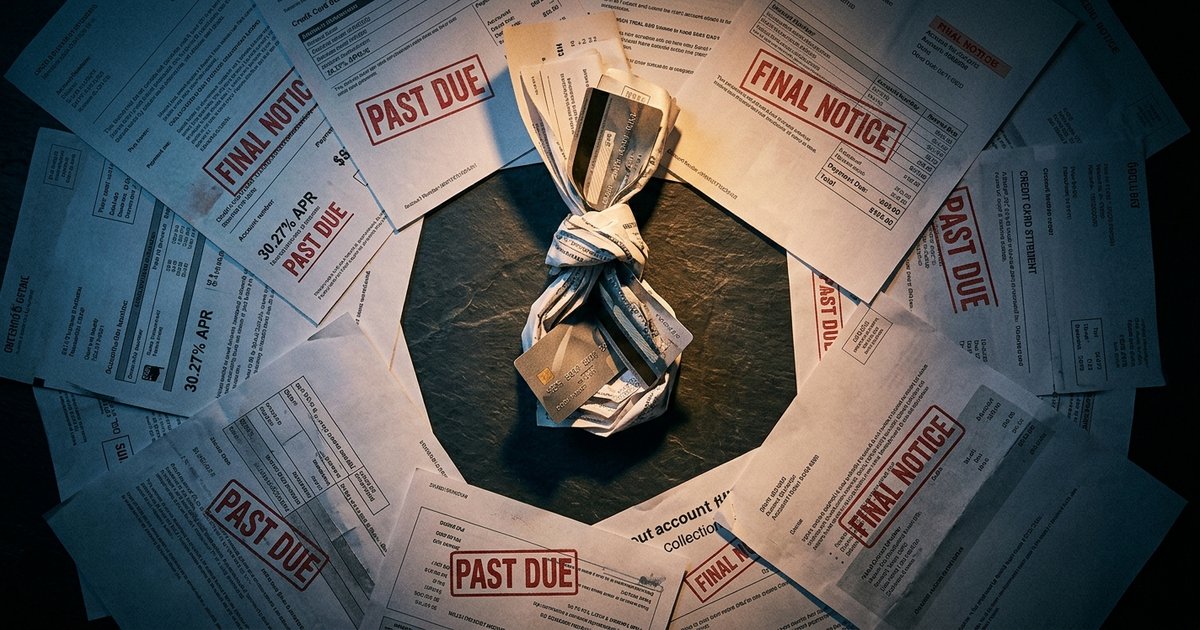
Somebody sold you on the idea that one payment fixes everything. One loan, one rate, one monthly bill, and suddenly you're on the road to financial freedom. I get it. When you're juggling four credit cards, a medical bill, and a collections notice, that pitch sounds like oxygen.
But here's what nobody running those ads wants you to calculate: for borrowers with credit scores below 600, debt consolidation frequently costs more than keeping the debt you already have. Not sometimes. Frequently.
Let me show you the math they don't put in the commercials.
The Promise Versus the Math
The pitch goes like this: take all your high-interest debts, roll them into one personal loan at a lower rate, make a single monthly payment, and pay it off faster. For someone with a 720 credit score, that story usually checks out. They'll qualify for a 10% or 12% consolidation loan against cards charging 22%. That's real savings.
You don't have a 720.
According to LendingTree marketplace data from December 2025, the average debt consolidation loan offer for bad credit borrowers was 30.27% APR. The median for borrowers under 600 sat around 32%. Meanwhile, the Federal Reserve's G.19 report showed the average credit card APR was 22.30% for accounts carrying balances in Q4 2025.
Read that again. The consolidation loan rate was higher than the credit card rate. The whole reason to consolidate, the rate arbitrage, simply disappears at the bottom of the credit spectrum. You'd be taking out a new loan to pay off cheaper debt with more expensive debt.
That's not consolidation. That's a downgrade with extra paperwork.
The Three Hidden Costs That Kill the Deal
Even in cases where the consolidation rate edges slightly below your weighted average card rate, three costs quietly eat up whatever savings you thought you had.
Origination Fees
Most bad credit personal loans charge origination fees between 1% and 10% of the loan amount. OneMain Financial charges up to 10% depending on your state. Upgrade goes as high as 9.99%. That fee comes straight off the top.
So you take out a $10,000 consolidation loan with a 5% origination fee. You receive $9,500 in your account, but you owe $10,000 plus interest. You just paid $500 for the privilege of rearranging your debt. NerdWallet estimates it takes 3 to 8 months of monthly savings just to break even on a typical origination fee. If your rate difference is slim, you might never break even at all.
Longer Repayment Terms
Consolidation loans for bad credit borrowers commonly stretch to 48 or 60 months. Your credit cards might have had you on track to pay off in 24 to 30 months if you kept pushing. A longer term means a lower monthly payment, sure. But it means paying interest for years longer.
A fifth of consolidation borrowers in a 2023 U.S. News survey said they specifically chose consolidation to lower monthly payments, then regretted it because the longer term kept them trapped in debt. Lower payment, higher total cost. That trade-off isn't always spelled out.
The Hard Inquiry Hit
When you apply for a consolidation loan, the lender runs a hard credit pull. That typically drops your score 5 to 10 points. If you're sitting at 580, you can't afford to lose 10 points. That dip might push you below a threshold that changes the terms you qualify for, or knocks you out of the running entirely with another lender down the road.
Add these three costs together, and the "savings" from consolidation can turn negative fast.
The "Empty Credit Card" Trap
This is the one that destroys people. I watched it happen hundreds of times sitting across from borrowers at my desk.
You consolidate $12,000 in credit card debt into a personal loan. Your cards now show zero balances. Your available credit just shot up. And every retailer, every online checkout screen, every "you're pre-approved" mailer is whispering for you to use it.
Six months later, you've got $4,000 back on the cards AND the consolidation loan. You didn't eliminate your debt. You doubled it.
Every major financial publisher (Experian, NerdWallet, CNBC, Credit Karma) identifies running up balances again as the single biggest risk of debt consolidation. Experian puts it bluntly: "If you continue to borrow more after consolidating your existing debt, your scores may not improve and you may end up in a worse financial position."
More than a third of consolidation borrowers in the U.S. News survey said they regretted the decision. Thirty-eight percent of those regretful borrowers said their interest rate was higher than expected. Nearly as many said their finances hadn't improved at all since consolidating.
The cards don't go away after consolidation. The temptation doesn't go away. And for many people, the spending habits that created the debt in the first place don't go away either. That's not a character judgment. It's a documented pattern.
How to Tell If Consolidation Actually Saves You Money
Before you sign anything, run this four-question test. If you can't answer yes to all four, consolidation is probably working against you.
- Is the consolidation APR lower than your weighted average card APR? Not your lowest card rate. Your weighted average, meaning the rate on each card multiplied by its balance, divided by total debt. If you owe $6,000 at 24% and $4,000 at 28%, your weighted average is 25.6%. The consolidation rate needs to beat that number, not just look lower than your highest card.
- Is the repayment term equal to or shorter than your current payoff timeline? If you'll be debt-free in 30 months on your current path but the consolidation loan is 60 months, you'll pay interest for an extra two and a half years. That wipes out rate savings in most scenarios.
- Can you commit to freezing or closing the paid-off cards? Not "I'll try to be disciplined." Can you actually freeze them in a block of ice, cut them up, or call the issuer and close the account? If the answer is "I'll keep them open just in case," you're setting yourself up for the reload trap.
- Is the origination fee less than three months of interest savings? If the new loan saves you $50 a month in interest but the origination fee is $400, you need eight months just to break even. And that's eight months where anything can go wrong.
Four yeses means consolidation might actually work for you. Anything less, and you need a different strategy.
Debt Settlement Dressed as Consolidation (the Scam You Need to Spot)
There's a darker version of this problem, and the CFPB has been warning about it for years.
Some companies advertise "debt consolidation" services, but what they're actually running is debt settlement. The difference matters enormously. Consolidation means a new loan that pays off existing debts. Settlement means a company tells you to stop paying your creditors, stashes your money in an account, then tries to negotiate reduced balances months or years later.
During that time, your credit score craters. One borrower profiled by CNBC Select saw her score drop over 100 points after signing up for what she believed was a consolidation program. It was debt settlement.
Red flags to watch for:
- They tell you to stop making payments on your debts.
- They charge fees before any of your debts have been settled. (Under the Telemarketing Sales Rule, it's illegal to charge advance fees for debt relief services sold by phone before the debt terms are actually changed and you've made at least one payment under the new terms.)
- They guarantee they can settle your debt for pennies on the dollar.
- They pressure you to sign up fast before "the offer expires."
- They refuse to explain exactly how the program works in writing.
The CFPB clearly distinguishes between credit counseling (nonprofit, educational), debt consolidation (new loan), and debt settlement (negotiated reduced balances). Consumers regularly confuse these three things, and bad actors exploit that confusion. Knowing how to spot loan scams and verify a lender can help you avoid these traps.
If a company contacts you offering "consolidation" and the first instruction is to stop paying your bills, hang up.
Three Alternatives That Don't Require a New Loan
Debt Management Plans Through the NFCC
A debt management plan (DMP) is run through a nonprofit credit counseling agency, typically affiliated with the National Foundation for Credit Counseling. Here's how it works: the counselor contacts your creditors, negotiates lower interest rates and waived fees, and sets up a single monthly payment that gets distributed to your creditors.
No new loan. No credit score requirement. No origination fee.
The NFCC tracked over 12,000 people through an 18-month study. Two-thirds of counseled clients reported better money management. Three-quarters were paying debts more consistently. Setup fees are typically $75 or less, and the monthly administration fee runs $25 to $50. Your first counseling session is free through NFCC member agencies.
Plans typically run 36 to 60 months. The catch: not all creditors participate, and you'll likely need to close the credit card accounts enrolled in the plan. But if your goal is to pay down debt without taking on more, this is one of the most underused tools available.
The Avalanche and Snowball Methods
The debt avalanche method means putting every extra dollar toward your highest-interest debt while making minimum payments on everything else. Once that one's gone, you roll the payment into the next highest rate. Mathematically, this saves the most in total interest.
The debt snowball method targets your smallest balance first, regardless of rate. You knock it out quickly, feel the win, then roll that payment into the next smallest. It costs a little more in interest, but the psychological momentum keeps people going. For a lot of borrowers, the method you'll actually stick with beats the method that's theoretically optimal.
Both cost you nothing to start. No application, no fee, no credit check.
Direct Creditor Negotiation
Pick up the phone and call your credit card issuers. Ask about hardship programs. Ask if they can lower your interest rate. Ask if they'll adjust your payment due dates so everything aligns with your paycheck schedule.
You'll be surprised how often it works. Card issuers would rather keep you paying at a reduced rate than send your account to collections. This isn't charity from the bank. It's math. A paying customer at 15% is worth more to them than a defaulted account they sell to a collector for 4 cents on the dollar.
When Consolidation Actually Makes Sense (Even With Bad Credit)
I'm not saying consolidation is always wrong. There's a narrow window where it works, even below 600.
If you can get a secured consolidation loan (backed by a savings account or other collateral) at a genuinely lower rate than your current debts, the math can work. Some credit unions offer secured personal loans in the 8% to 15% range, even for members with poor credit. That's a real rate reduction against cards charging 24% or more.
Consolidation can also make sense if your total debt is small enough that origination fees are minimal, and the term stays short. Consolidating $3,000 at a 2% origination fee is a $60 cost. That's manageable. Consolidating $15,000 at a 6% origination fee is $900 out of your pocket before you've reduced your debt by a dime.
If you do decide to consolidate, looking beyond APR at the full loan comparison checklist will help you evaluate the total cost, not just the headline rate.
The point isn't to avoid consolidation on principle. The point is to do the actual math with your actual numbers, not the numbers in the advertisement.
Frequently Asked Questions About Debt Consolidation With Bad Credit
Is debt consolidation a good idea if I have bad credit?
It depends entirely on the numbers. If the consolidation loan APR is higher than the weighted average rate on your existing debts (which is common for scores below 600), it will cost you more, not less. According to LendingTree, the average consolidation loan offer for bad credit was 30.27% APR in December 2025, while average credit card rates were around 22.30%. Always compare your specific rates before deciding.
What is the biggest risk of consolidating debt?
The freed-up credit card trap. After you use a consolidation loan to pay off your cards, those cards show zero balances with full available credit. The temptation to spend on them again is the single most commonly cited risk across every major financial publisher. If you consolidate and reload the cards, you end up with double the debt.
How do I know if a debt consolidation company is a scam?
Watch for companies that tell you to stop paying your creditors, charge fees before any debt has been settled, or guarantee specific results. These are hallmarks of debt settlement operations disguised as consolidation. The CFPB warns that it's illegal under the Telemarketing Sales Rule to charge advance fees for debt relief sold by phone before the debt terms have actually been changed.
What is a debt management plan and how is it different from consolidation?
A debt management plan is run by a nonprofit credit counseling agency. The counselor negotiates lower rates with your existing creditors and sets up a single monthly payment distributed to those creditors. You don't take out a new loan, there's no origination fee, and there's no minimum credit score. Plans typically run 36 to 60 months. The NFCC offers free initial counseling sessions.
What is the debt avalanche method?
The debt avalanche directs all extra payments toward your highest-interest debt first while making minimum payments on everything else. Once the highest-rate debt is gone, you roll that payment into the next highest. It saves the most money in total interest over time and costs nothing to start.
Can I negotiate directly with my credit card company to lower my rate?
Yes. Call your issuer and ask about hardship programs or rate reductions. Credit card companies often prefer keeping you as a paying customer at a lower rate over sending your account to collections. There's no fee, no credit check, and no application. It's one phone call.
